
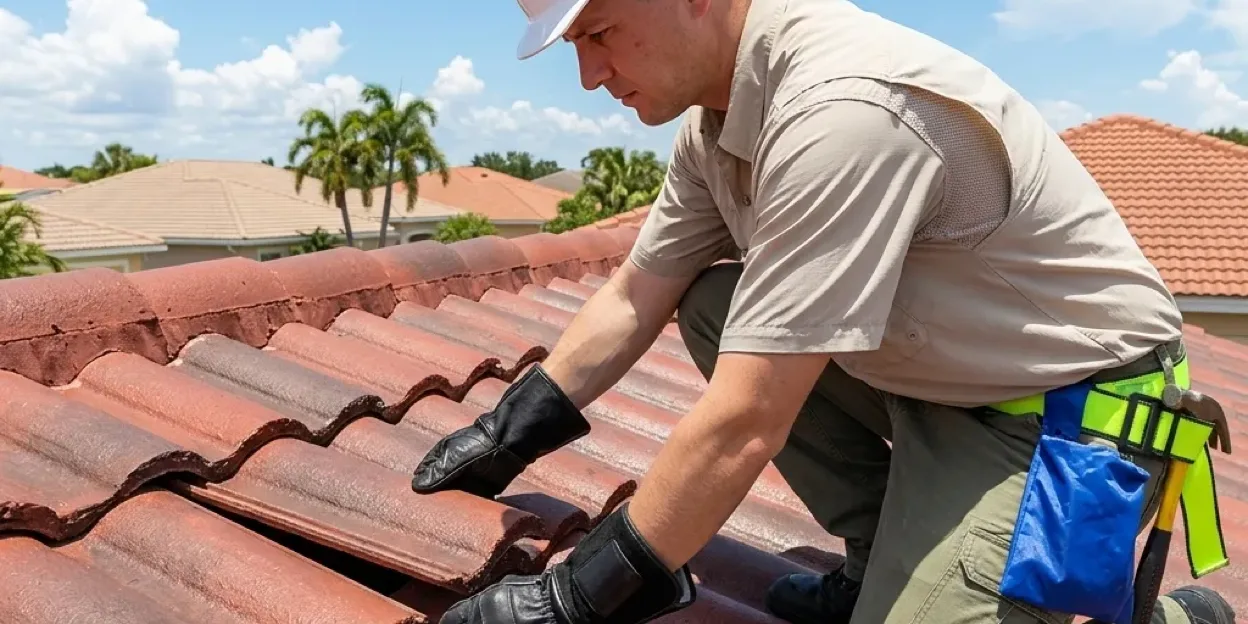
You are buying a house in Deep Creek. The listing says the roof is from 2006. The seller says it has never leaked. Your insurance agent says the carrier wants a roof condition report before they will bind the policy, and the closing is in three weeks. This site connects you by phone with an independent local contractor who does roof inspections in Charlotte County.
The contractor walks the roof, not the driveway. On tile they check for cracked, slipped, and walked tiles, and lift a few to look at the underlayment. On shingle they look for granule loss, creasing, and lifted tabs. On metal they check fasteners, seams, and any rust at the cut edges. Then the places where leaks actually start: flashings, valleys, pipe boots, skylights, and the ridge.
Where there is attic access they look at the underside of the deck for staining and daylight, and take moisture readings if something looks wet. Everything lands in a written report with dated photos and a plain statement of condition and remaining life.
Find the permit date for the roof if you can. It is on the county permit search or in the sale papers. Gather any letter from the insurer so the contractor knows exactly what the carrier is asking for; a roof condition report and a 4-point inspection are different documents, and a wind mitigation form is a third. Then call.
If a storm just came through and nothing looks wrong from the street, call anyway. Wind damage hides, and the report that says the roof is fine is worth having in writing.
The report covers the covering, the flashings and penetrations, the visible deck, and the drainage. It states the roof's condition and, when the insurer needs it, an estimate of remaining useful life. It is a statement of condition on the day of the visit, not a warranty, and it is not a claim document on its own, though its photos often become the "before" pictures in one.
If the inspection finds a repairable problem, the contractor writes a separate scope for roof repair. If it finds underlayment at the end of its life, the next step is a roof replacement conversation, and the report should say so rather than bury it.
Roof age drives most inspection calls in this county. A large share of roofs went on in 2004 through 2006 after Charley, and they are now past fifteen years, the point at which Florida law lets an insurer request an inspection. An inspection showing five or more years of remaining life keeps the policy in force.
The county's roofs also carry two storms' worth of hidden damage. Ian's eye crossed Charlotte Harbor in September 2022 and Milton followed in October 2024. Creased shingles from either storm fail months later, and ridge tiles that shifted an inch wait for the next rain band. A post-storm inspection with photos also starts the one-year clock on a claim with something on paper.
Seasonal owners in Rotonda West, Punta Gorda Isles, and Burnt Store often book an inspection before leaving in April, so a dated report is on file before the season starts. Buyers of manufactured homes along US 41 and around Harbour Heights should say so when they call, since those roofs are inspected by different rules.
Have the address and the year the roof went on, if you know it. Be ready to say who needs the report: an insurer, a buyer, a lender, or you. Say whether a storm has come through since the roof was last looked at. Call (941) 294-6154.
 Standing by
Describe what you see in plain words. The call is routed to an independent local roofing contractor who works tile, metal, and shingle roofs in your part of Charlotte County.
The state OIR-B1-1802 form completed on your roof's straps, deck nailing, and water barrier, so your agent can apply the credits.
Dated photos, a line-item scope, and a contractor at the adjuster visit, so the claim is about what the roof shows.
A leak traced to its real entry point, then the flashing, boot, tile, or shingle that let it in put right and photographed.